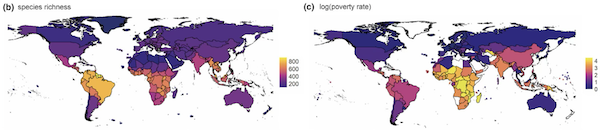
The mainstream narrative holds that countries rich in biodiversity can use this natural capital to reduce poverty. In theory, higher biodiversity ought to mean lower poverty. In practice, the opposite tends to be true. Countries with the highest levels of biodiversity also tend to have higher poverty rates. This paper explores how this paradox emerged. It finds that colonial and neoliberal structures have produced an inverted biodiversity–poverty relationship. Biodiversity-rich regions were more likely to be colonised, and less likely to have developed strong pre-colonial states, which further increased the likelihood of colonisation. Colonial rule locked these economies into the export of raw materials, creating high dependence on natural resource rents and weakening governance. Lower state capacity was associated with higher debt burdens and, ultimately, higher poverty rates. In short, Western European colonial powers disproportionately targeted biodiverse regions, creating poverty legacies that persist today. These patterns are not merely historical residues: they continue to be reinforced by contemporary global trade rules, particularly through unequal exchange relationships.
-

Unequal exchange fuels conflict
The relationship between ecologically unequal exchange (EUE) and environmental conflicts is foundational to understanding resource extraction dynamics between centre and periphery regions of the world system. EUE shows asymmetric flows of energy and materials between the two regions, with environmental impacts “outsourced” to the periphery. This study analysed 96 environmental conflict cases from the EJAtlas database involving French or Chinese companies in Africa. The substantial drain of biophysical resources from Africa to France and China has profound impacts on local systems, often triggering environmental conflicts as communities resist extractive practices. The study states that French and Chinese firms’ operations in Africa significantly contribute to material exports to their home countries. The conflicts that arise from these operations, as shown in the graph, are an adequate proxy to comprehend the local impacts of EUE.
-
Who Really Works for Whom?
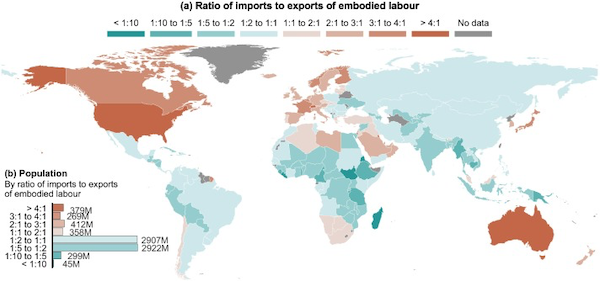
We know that global trade transfers human effort from the Global South to the Global North, but what does this look like at a more granular level? In 2018, for every full-time worker in the United States producing exports, the country imported goods and services equivalent to the labor of 7.3 full-time workers abroad. This made the U.S. the world’s top net importer of “embodied labour.” Other top net importers included Australia (net-importing 4.26 full-time workers), Luxembourg (4.43), Kuwait (4.51), and Hong Kong (5.23). Conversely, South Sudan exported goods and services equivalent to the work of 16.9 full-time workers for every one worker producing its imports. It was followed by Eritrea (net-exporting 15.6 full-time workers), Madagascar (13.9), Liberia (10.6), and Tanzania (9.3). You can check how this works out in your own country in this dataset. This imbalance is not random; it reflects a clear North-South divide, as illustrated by this map. The map also reveals that 6.2 billion people live in nations exporting more embodied labor than they import, while 1.4 billion reside in countries benefiting from net labor imports.
-

The Decoupling Delusion
Money is a human invention, unbound by physical laws—it can be created or destroyed at will. So could economic growth continue even if physical expansion stalls? The concept of “decoupling” suggests it might. The figure conceptualises what decoupling would hypothetically require. Model A assumes endless economic growth (red), even as physical activity (blue) plateaus. This demands that the non-physical sector (purple) dominate, approaching 100% of economic activity. First of all, empirically we see that the economy is becoming more resource intensive, not less. But even if we could change course, thermodynamics imposes hard limits: every process involves losses, dissipation, and degradation. Recycling requires more energy generation, which requires material resources, which also degrade over time. No matter how efficient we become, finite resources and thermodynamic constraints will eventually cap growth. Model B presents a more realistic scenario: non-physical growth is capped, allowing only modest decoupled growth before levelling off. Preparing for a post-growth world isn’t just wise—it’s inevitable.
Murphy Jr, T. W. (2022). Limits to economic growth. Nature Physics, 18(8), 844-847.
-
The Hidden Subsidies of Unequal Exchange
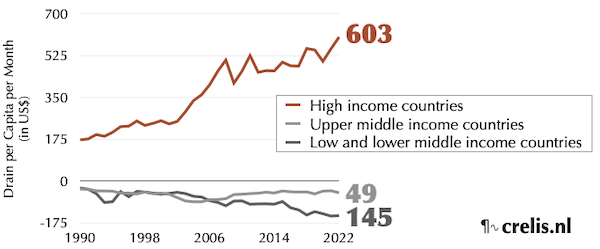
We are supposed to believe that capitalist trade is a system of mutual benefit, yet in reality it functions as a mechanism that redistributes human effort and natural wealth unevenly across the globe. This “unequal exchange” is best understood not as a set of isolated imbalances, but as the convergence of disparities in labour, materials, money, and currency that systematically advantage the global “centre” while extracting from the “periphery.” This process generates trillions in gains for wealthy economies while imposing severe proportional losses on poorer ones. The graph illustrates a widening pattern: by 2022, the average employed person in the centre effectively saved between US$213 and US$603 per month due to unequal exchange, while those in the periphery lost out on between US$35 and US$145 monthly. It is important to note that these figures are averages, with further inequalities persisting within both regions. The point is that these are not temporary distortions but structural features of the system, suggesting that justice cannot be achieved by trying to rebalance capitalism, but by abandoning it altogether.
-
How Unequal Exchange Undermines Local Needs
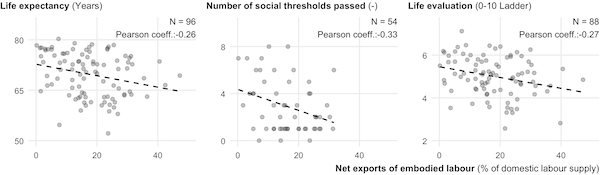
The global distribution of work is deeply uneven: high-income countries benefit from large amounts of labour performed abroad while contributing relatively little of their own, leaving lower-income countries to export a significant share of their labour in a zero-sum system. The graph highlights the consequences of this imbalance, showing that as net exports of embodied labour (measured as a share of domestic labour supply on the horizontal axis) increase, key social outcomes—like life expectancy and overall well-being—tend to decline. In other words, countries that devote more of their workforce to serving foreign demand often have fewer resources left to meet local needs. That said, the relationship is relatively weak (with correlations between −0.26 and −0.33), suggesting that while reducing unequal labour exchange may be necessary for achieving decent living standards, it is far from sufficient on its own.
-
The Global Structure of Dependency
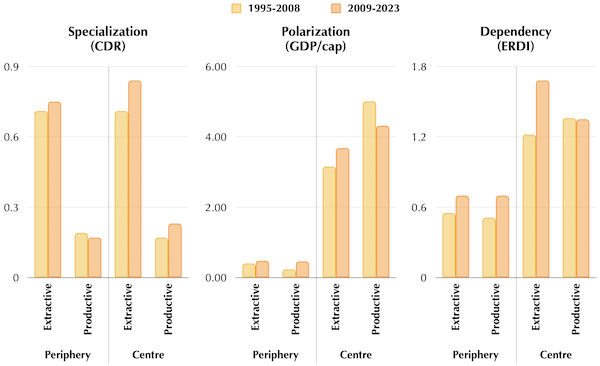
This graph classifies countries into centre (above-average GDP per capita) and periphery (below-average), then further into productive or extractive based on their commodity dependence ratio (CDR): those with over 60% of exports in primary goods are extractive; the rest, productive. It also tracks two structural imbalances—polarisation, via normalised GDP per capita, and dependency, via the Exchange Rate Deviation Index (ERDI), which measures divergence between market exchange rates and purchasing power parity (PPP). Covering 1995–2008 and 2009–2023, the data reveals three key trends: the productive centre’s share of global manufacturing exports shrinks while the productive periphery grows, reflecting offshoring and centre deindustrialisation; industrial growth in the periphery has not closed the income gap, challenging the idea that industrialisation leads to convergence; and persistent currency undervaluation in the periphery entrenches unequal terms of trade.
-
The Extraction-Consumption Inversion
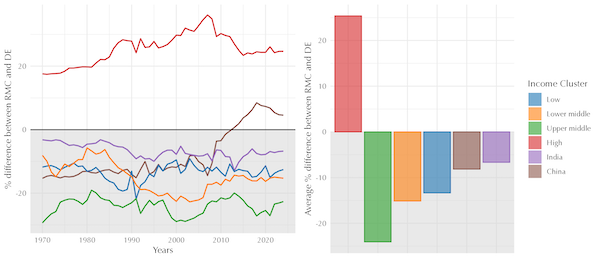
From 1970 to 2024, global resource extraction surged from 31 to 106 gigatons, with about 30 percent consistently tied to traded goods. This growth is marked by stark inequalities and a zero-sum dynamic: more resources flowing to high-income countries means fewer for low-income ones. Based on data tracking traded raw materials and their embodiment as Raw Material Equivalents (RMEs) in (semi-)finished products, the group of high-income countries is the only one with cumulative net imports, totalling 290 Gt. All other income groups were net exporters, with low-income countries collectively exporting 9.6 Gt. The graph here adds an important nuance: while their exports are the smallest in absolute terms, the drain is significant relative to what they extract. As a group, low-income countries consumed 13.3 percent less than they extracted, sending the rest to global markets. Meanwhile, high-income countries consumed 24.1 percent more than they extracted, bridging the gap with imports.
-
Winners and Losers in Raw Material Trade
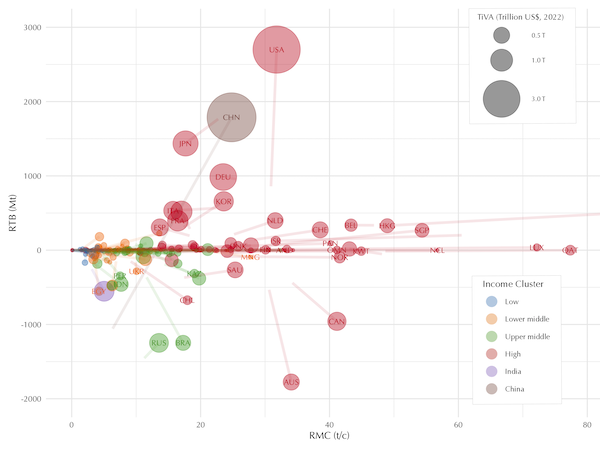
This graph illustrates ecological unequal exchange—a theory that challenges the idea that trade benefits all. Instead, it shows how global trade deepens injustices through uneven resource flows. On the y-axis: Raw Material Trade Balances (RTB). A positive RTB means a country is a net importer of embodied raw materials (used anywhere along the supply chain). A negative RTB means it’s a net exporter. Colours indicates income levels, and the pattern is clear: wealthy nations dominate the importing side draining resources from the rest of the world, with notable outliers like Australia and Canada, which export more than they import. The x-axis shows per capita Raw Material Consumption. Lower-income countries cluster on the left, consuming far less per person. Trend lines from 1992 to 2022 show rising global consumption—especially among wealthier nations. But China stands out: once a major exporter, it now imports more than it exports and is rapidly approaching U.S. consumption levels. The bubble size reflects 2022 Domestic Value Added—the total value captured from trade. The U.S. and China lead, each capturing over $3 trillion. A grim pattern emerges: the farther a country is from trade balance (RTB = 0), the larger the bubble. In other words, the more a country exploits the environment, whether abroad (e.g., U.S., China, Japan, Germany) or domestically (e.g., Australia, Canada, Russia, Brazil), the more it earns.
-
Will technology save Thelma and Louise?
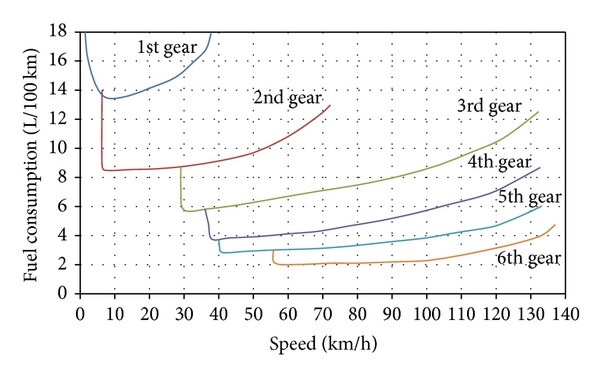
Thelma and Louise go on a road trip to escape their mundane lives. Things escalate: Louise shoots a man, and the police give chase. They floor the gas, but more speed means more fuel burned. “No problem,” says Louise. “Gear shifting helps—higher gears let the engine run at lower revolutions and improve efficiency!” This is indicated by the short vertical lines in the graph. But once they’re in top gear, efficiency peaks. Any further speed increase demands more fuel as shown by the bottom-right curve—a basic but inconvenient law of physics. Efficiency only delays the inevitable. Cornered by the police at the Grand Canyon, Thelma and Louise accelerate toward a cliff. The faster they go, the less time they have to stop. Eventually, stopping is no longer an option. “No problem,” says Louise. “As fuel burns, the car gets lighter—soon we won’t even need the road. We’ll fly, Thelma!” At which point the problem is no longer the cliff, but that they’re heading toward the sun, and combustion engines don’t do well there. “No problem,” says Louise. “We’ll just get a Tesla.”
Source: Thanks DC for the inspiration. Nasir, M. K., Md Noor, R., Kalam, M. A., & Masum, B. M. (2014). Reduction of fuel consumption and exhaust pollutant using intelligent transport systems. The Scientific World Journal, 2014(1), 836375.