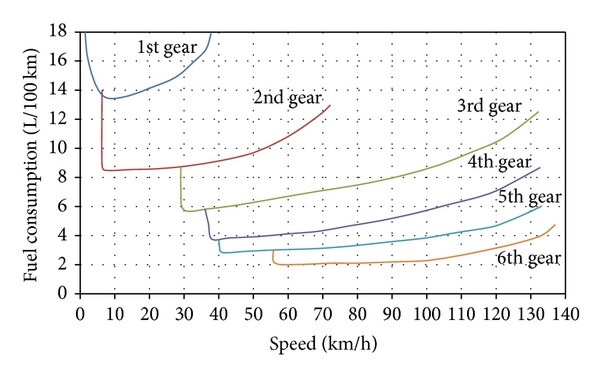
Thelma and Louise go on a road trip to escape their mundane lives. Things escalate: Louise shoots a man, and the police give chase. They floor the gas, but more speed means more fuel burned. “No problem,” says Louise. “Gear shifting helps—higher gears let the engine run at lower revolutions and improve efficiency!” This is indicated by the short vertical lines in the graph. But once they’re in top gear, efficiency peaks. Any further speed increase demands more fuel as shown by the bottom-right curve—a basic but inconvenient law of physics. Efficiency only delays the inevitable. Cornered by the police at the Grand Canyon, Thelma and Louise accelerate toward a cliff. The faster they go, the less time they have to stop. Eventually, stopping is no longer an option. “No problem,” says Louise. “As fuel burns, the car gets lighter—soon we won’t even need the road. We’ll fly, Thelma!” At which point the problem is no longer the cliff, but that they’re heading toward the sun, and combustion engines don’t do well there. “No problem,” says Louise. “We’ll just get a Tesla.”
Source: Thanks DC for the inspiration. Nasir, M. K., Md Noor, R., Kalam, M. A., & Masum, B. M. (2014). Reduction of fuel consumption and exhaust pollutant using intelligent transport systems. The Scientific World Journal, 2014(1), 836375.
Leave a Reply