Commodifying Plunder
Unequal Exchange and the
Hidden Logic of Imperialism
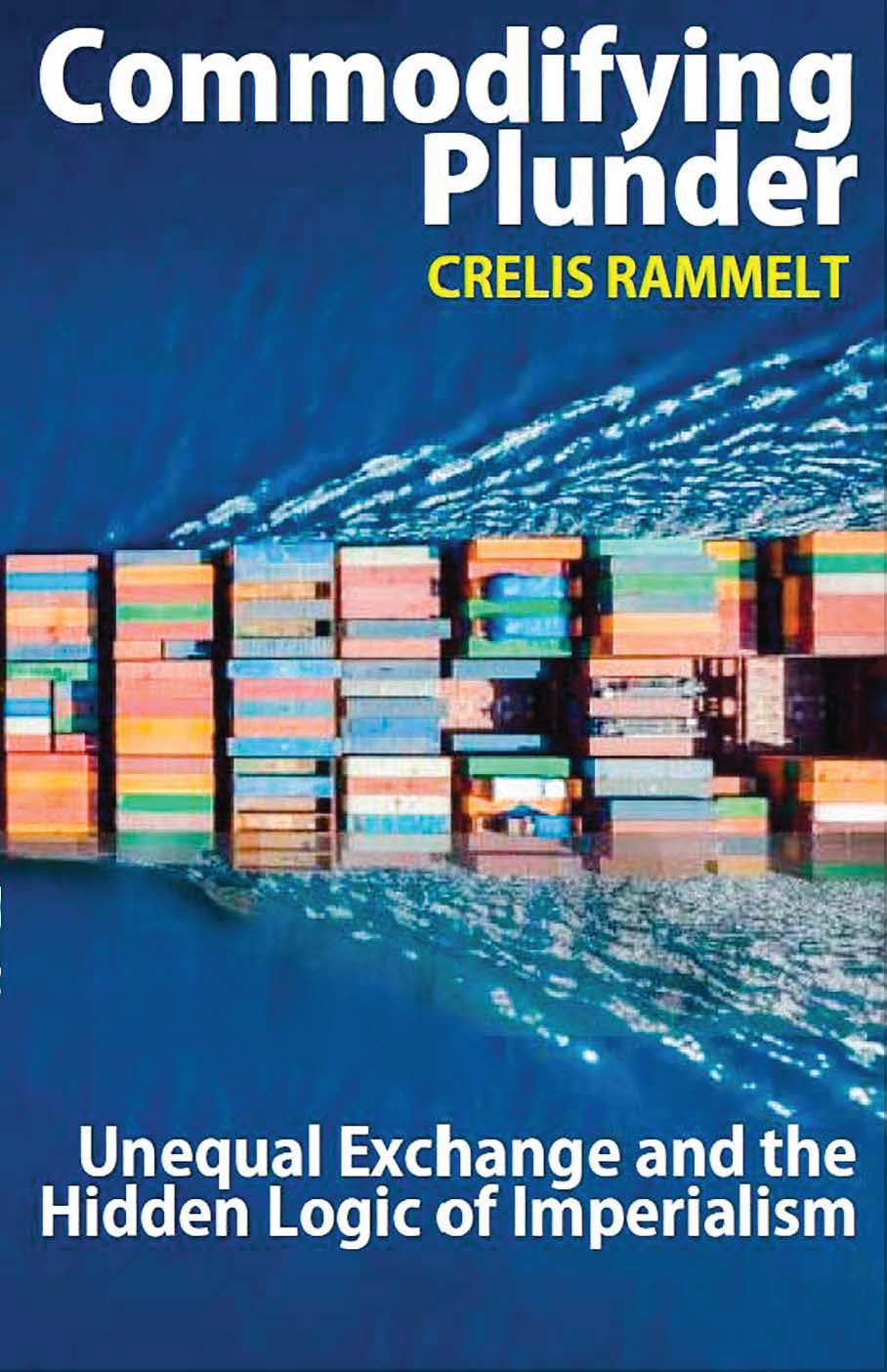
Once thought to be a bygone concern, imperialism has re-emerged, both in protest slogans and in academic debates. This book intervenes in that revival by offering a fresh and accessible interpretation of imperialism in its modern form: Unequal Exchange, a trade-driven transfer of wealth from the periphery to the center of the world system. In this form, imperialism no longer requires military occupation or monopoly capital; instead, value is covertly extracted through seemingly ordinary market exchange — what I call Commodified Plunder.
Published by:

Supported by:


Events
Book launch, 2 November 2026, 12:30 -13:30 CET, University of Amsterdam, see details and registration here.
Endorsements
Unequal exchange—in both its economic and ecological forms—lies at the root of modern imperialism, explaining how one country can grow at the expense of another under modern capitalism. However, such inequalities in exchange are to a large extent hidden by the operation of the price system, only revealed via Marxian value analysis. Among the numerous works written on this subject in recent years, very few are at once theoretically comprehensive, empirically sophisticated, and widely accessible. Among these Crelis Rammelt’s Commodifying Plunder: Unequal Exchange and the Hidden Logic of Imperialism is quite possibly the best.
John Bellamy Foster, author (with Fred Magdoff) of Grand Theft Capital: What Workers Should Know About the Affordability Crisis
“Commodifying Plunder presents an urgent and compelling argument, backed up by rigorous research and a stringent logic. It challenged me as a reader with its level of complexity, but that complexity never felt pretentious or gratuitous: all steps were clearly explained so that I could follow along even without any specific technical knowledge. I genuinely feel that I have developed a much better understanding of how capitalist trade works, and I’m grateful for that!”
Valentina Carraro, Assistant professor, Political and Economic Geographies
“I loved your chapter that we read during the course. Your writing style is really fun to read and I appreciate how it is a text for all and not only other academics.”
Geira Sol, Master Student, International Development Studies
“Commodifying Plunder is a sign that the political economy of imperialism is back on the agenda again after fifty years in the shadow of neoliberal globalization. The book unveils the hidden logic of imperialist value transfer. Crelis Rammelt’s understanding of unequal exchange is firmly rooted in Marx’s theory of value. By combining the economic and ecological aspect of imperialism, he brings the theory of unequal exchange into the 21st century.”
Torkil Lauesen, anti-imperialist activist, member of the Arghiri Emmanuel Association, and author of Unequal Exchange, Past, Present and future
“Finally! An engaging, accessible introduction to a vitally important set of analytical tools for understanding the roots of socio-environmental exploitation. A must read for anyone interested in a sustainable planetary future.”
Robert Fletcher, Personal Professor of Political Ecology, Sociology of Development and Change
“This book is a clear and accessible map of the current geopolitical condition. A must read for all those who wish to understand today’s neo-imperial mutations of capitalism and its instable militarized geopolitics. Crelis Rammelt first shows us why imperialism exists and how it works. He exposes the ever-pressing needs of the minority world to exploit, enslave, dispossess, and abuse of the human and environmental wealth of the majority world. He also provides us with concrete tools to contest it.”
Federico Savini, Associate Professor in Environmental Planning, Institutions and Politics
Content
The book is divided into two parts. Part I introduces the Marxist value framework, providing the foundation for understanding global value transfers through unequal exchange, which is explored in Part II. Both parts can also be read independently: Part I for those new to Marx’s Capital, and Part II for readers already familiar with it.
Chapter 1: Introduction
This book starts with a blunt question: How do rich countries get richer off poor ones without war or conquest? The answer: trade. It’s inherently violent, not the “win-win” we’re sold. Using fifty years of global data, this introduction dismantles the myth that trade lifts all boats. Instead, we see deepening inequality—between nations, within societies, between capital and labour, and in control over resources, wealth, and pollution. Meanwhile, poverty isn’t falling; it’s rising when measured realistically.
These facts alone do not show how enrichment and impoverishment are connected. This is why we need unequal exchange theory. The introduction tackles three core questions: What is exchange under capitalism? What is capitalism? What makes this exchange unequal? It then outlines the book’s goal: to arm activists, scholars, and organizers with the tools to debunk trade’s myths and challenge modern imperialism.
Part I: Value Framework
Chapter 2: Value
This chapter builds the book’s theoretical backbone by defining Marxist value as socially necessary labour time, not price. We will see how value is produced, realised as money, and reinvested in an ever expanding cycle of accumulation, turbo charged by finance. We unpack productivity, labour intensity, and Marx’s core categories—constant capital (materials and machinery), variable capital (labour), the organic composition of capital (their ratio) and the rate of exploitation—which later helps explain the drivers of unequal exchange.
Next, the chapter distinguished value from use value and exchange value. Use value, especially drawn from nature, sets the stage for Chapter 7: Ecological Unequal Exchange. Finally, we start thinking about the transformation of values into prices using the Monetary Expression of Labour Time (MELT): total price divided by total value. MELT becomes our tool for spotting price value gaps between sectors in Chapter 4: Price and Profit, and between nations in Chapter 6: Unequal Exchange.
Chapter 3: Surplus Value
This chapter shows how capital accumulation hinges on surplus value: an additional boost of value commodities get above the outlays of constant and variable capital. The amount of surplus-value depends on the rate of exploitation: the ratio between necessary labour (the paid working time required to reproduce labour power) and surplus labour (the unpaid working time that generates profit). I explain some of the capital’s methods to boost this rate.
We then see how labour itself carries value, which transfers into the commodities, and how total commodity value ends up including surplus value. I then remind readers that prices diverge from values, causing profit to stray from surplus value (which leads to unequal exchange when the logic is applied on a global scale). The next chapter unpacks exactly how this divergence occurs. Finally, I introduce the concepts of simple, expanded, and maximum reproduction as tools for tracing how surplus value drives endless accumulation (and, later, deepens unequal exchange over time).
Chapter 4: Price and Profit
This chapter tackles one of Marxism’s toughest nuts, and an often overlooked, yet essential step in Capital Volume III: the transformation problem. It pulls the whole system into view, showing how and why market prices drift from labour values and profits from surplus value. As opposed to all sorts of extra-economic influences on prices, these divergences stem from capitalism’s inner dynamics. Some sectors pocket surplus profits above the value they add, while others under perform. Why? Because commodities sell at production prices—that is, cost plus an average profit rate equalised across the economy, thanks to capital mobility. Labour saving industries, whose goods embody less (surplus-)value as a result, still reap full average profits, creating systematic gaps between prices and values. I build this logic step by step, with clear, concrete examples.
Finally, the chapter confronts the hot button issue of the falling average profit rate. Since profits stem from surplus value—and surplus value from labour—widespread automation erodes the overall profit rate over time. Revisiting last chapter’s reproduction schemes, now adding the realisation of values into prices, reveals how short term cost advantages turn into long term squeezes on profitability. This tendency, Marxists argue, propels capital’s expansion beyond national borders (and therefore underpins the emergence of unequal exchange).
Part II: Value Transfers
Chapter 5: Uneven Development
This chapter maps the deep historical roots of uneven development and paves the way for the next chapters’ theoretical roots. Drawing on the book’s opening data, it upends the myth of trade as a win-win and shows how capitalism has long split the world into dominant centres and dependent peripheries. In its colonial phase, capitalism forged this hierarchy through slavery, enclosures, theft, and forced deindustrialization. Even after formal decolonization, peripheries stayed locked into low wage, extractive, labour intensive roles, while centres retained high value, capital intensive industries.
That structural divide triggered debt crises, structural adjustment programs, and the growing reliance on foreign capital, leading to today’s monopoly capitalism and corporate controlled global value chains. And even where periphery nations did industrialize, most of the gains still flowed back to the centres. Uneven development isn’t about what’s produced but the power-laden conditions of production and exchange. The chapter closes by discarding Ricardian free trade myths and anchoring unequal exchange in three more realistic assumptions: mobile capital, immobile labour, and global wage gaps.
Chapter 6: Unequal Exchange
This chapter unpacks how unequal exchange siphons value from periphery to centre, not because of what’s produced, but how it’s produced. It comes in two forms. Broad unequal exchange stems from productivity gaps: centre countries deploy more machines and materials (constant capital). Strict unequal exchange arises from wage gaps: higher wages in the centres (more variable capital and a lower exploitation rate). In both cases, the periphery exports more value at lower prices; the centre exports less value at higher prices. Value flows from low-wage, low-productivity economies to high-wage, high-productivity ones. As technology diffuses and productivity gaps shrink, wage gaps may take the lead.
Next, I outline an accessible method to estimate unequal exchange using labour trade balances, value added gaps, and price differentials. It reveals a hidden global subsidy of $500–600 per person per month flowing to high income countries as a result of unequal exchange. Finally, I reflect on what such estimates can and can’t reveal.
Chapter 7: Ecological Unequal Exchange
This chapter shifts focus from trade’s value transfers to global resource flows, drawing on eco-Marxism and ecological economics. Ecological unequal exchange, initially developed by Bunker, Hornborg, and others, shows how capitalist centres extract resources and offload waste onto peripheries. Following eco-Marxist thinkers, this fuels a distorted “social metabolism” and triggering metabolic rifts and shifts.
I advocate integrating value-based and ecological approaches to unequal exchange while keeping labour and resources analytically distinct. For Marx, capitalism turns nature’s free use-values into constant capital, which serves to boost productivity and generating rents. This potential fuels the expansion of resource frontiers and extractivism.
Here too, I present an accessible method using material trade balances, value-added gaps, and price-level differentials to quantify ecological unequal exchange. The result is stark: the periphery captures ~$100 of value-added per ton of embodied raw materials, the core nearly $800. I conclude by linking both methods to show how unequal exchange combines material, labour, monetary, and currency imbalances.
Chapter 8: Conclusions and Ways Forward
Unequal exchange remains contested in academic debates, often at a high level of abstraction. This final chapter begins with a brief recap of the chapters’ theoretical contributions and the book’s core aim: to offer an accessible, integrated framework of unequal exchange, including all its imbalances, as a tool for struggle, not just scholarship.
The chapter then turns to strategy, emphasizing the need to bridge often disconnected, and at times oppositional social and environmental justice movements that are, in fact, resisting the same system. The integrated framework offered in this book can help build a more unified, anti-capitalist, and anti-imperialist politics.
While the book focuses on how unequal exchange operates rather than how to escape it, I conclude with some possible strategies. These range from reformist (e.g., wage laws, trade certifications, bans on forced labour), to structural (e.g., regional trade blocs, alternative currencies, welfare-based trade), and finally to more radical delinking from global capital via resource sovereignty, import substitution, capital controls, debt cancellation, and monetary autonomy. These strategies align with degrowth and other anti-capitalist movements.
About the author
My name is Crelis Rammelt and I am associate professor at the University of Amsterdam, specialising in environmental geography and international development studies. Originally trained as an engineer, my work now spans political ecology, Marxist political economy, ecological economics, post-development, and systems science—always with a focus on justice. I currently teach several interdisciplinary courses, with a focus on system dynamics, degrowth, the capitalocene, and environment-development issues. For many years, I have also coordinated an action research and water justice program together with communities in Bangladesh and I have helped establish the Dutch degrowth platform Ontgroei in the Netherlands.


Further resources
Publications
Talks
Other
Rammelt, Crelis (2026). Blog post: Unequal Exchange Explained to a 10-year-old