Wealthy nations outsource their land use

Land use is becoming more globalised, easing pressure on local ecosystems in some areas but raising pressures elsewhere. This study finds that wealthier countries rely less on local and more on imported resources, using the concept of “embodied human appropriation of net primary production” (eHANPP), which tracks how much of the natural inflow of energy and biomass into the biosphere (NPP) humans appropriate through the harvesting or burning biomass and converting natural ecosystems to managed lands. The study identifies five land-use clusters: exporters, outsourcers, intensifiers, intermediates, and the self-sufficient. Exporters like Australia and Canada lead in per capita eHANPP exports, while self-sufficient nations in Africa and Asia rely heavily on local resources. Intensifiers have high energy and material use per biomass unit. Outsourcers, mainly wealthy European countries, depend on eHANPP net-imports, using 43% of their own NPP and importing similar amounts, while consuming four to five times more energy and materials than the global average.

Source: Dorninger, C., von Wehrden, H., Krausmann, F., Bruckner, M., Feng, K., Hubacek, K., … & Abson, D. J. (2021). The effect of industrialization and globalization on domestic land-use: A global resource footprint perspective. Global Environmental Change, 69, 102311.

Drain of labour from global South to North

In 2021, the global North exported commodities representing 80 billion hours of labour while importing 906 billion hours from the global South. This resulted in a net drain of 826 billion hours, which is equivalent to the full-time efforts of 369 million workers—more than the combined workforce of the United States and the European Union. Each year, the North consumes approximately twice as much labour as it produces. In 2021, net-appropriated labour accounted for 46% of the North’s total labour consumption, as shown in the figure. The figure also illustrates that the economies of the global North have become increasingly reliant on low-skilled labor, with 71% of it being net-appropriated from the global South in 2021. The drain of 826 billion hours translates to a €16.9 trillion windfall for the global North, more than double the figure in 1995. Between 1995 and 2021, these gains amount to €310 trillion.

Source: Hickel, J., Hanbury Lemos, M., & Barbour, F. (2024). Unequal exchange of labour in the world economy. Nature Communications, 15(1), 6298.

“Safe and just” requires redistribution

The “safe and just operating space” envisions meeting human needs without breaching the planet’s environmental limits. This graph compares the impacts of achieving “decent living standards” (DLS) against “planetary boundaries” (PBs). The results show that reducing consumption to DLS levels (while increasing it for those below, as others also argued), without transforming provisioning systems, cuts impacts by about half (confirmed by other studies). However, this alone won’t bring us into the “safe” zone, as climate, biodiversity, and nitrogen PBs would still be breached. A “safe and just” outcome for up to 10.4 billion people is possible, but it requires redistributing resources (to DLS levels), transitioning to fossil-free energy systems, adopting largely vegan diets, and halting further land conversion.

Source: Schlesier, H., Schäfer, M., & Desing, H. (2024). Measuring the Doughnut: A good life for all is possible within planetary boundaries. Journal of Cleaner Production, 448, 141447.

Decent living with 30% of the footprint

The idea that all countries need to reach high-income GDP levels to end poverty is unrealistic, especially considering the imperialistic reliance of high-income countries on resource drains from the low-income countries. Also, ending poverty under current conditions would further speed up ecological collapse, especially if we were to use a more realistic poverty line. Instead of allowing endless profit and growth, we should focus on meeting human needs through targeted production, public provisioning, and decommodification. Wealthy countries should scale down unnecessary production to cut emissions and reduce resource use. This approach allows decent living standards for 8.5 billion people with just 30% of current global resource use. Good news, but not easy to achieve, as it requires shifting away from profit-driven capitalism and building sovereign capacity in the global South.

Source: Hickel, J., & Sullivan, D. (2024). How much growth is required to achieve good lives for all? Insights from needs-based analysis. World Development Perspectives, 35, 100612.

Five Netherlands

The Netherlands has a significant land-use footprint, primarily driven by imports. Despite the country’s total surface area of 4.2 million hectares, which includes inland and open water, only 2.0 million hectares are dedicated to arable land, permanent crops, and pastures for agricultural and forestry activities. However, the Netherlands supplements its limited domestic land with a staggering 20.3 million hectares of imported land use. When taking exports into consideration, the net trade land-use expands to 18.8 million hectares. Overall, the Netherlands’ total land-use footprint reaches 20.8 million hectares, which is more than five times its own surface area! This extensive footprint illustrates the heavy reliance of the Netherlands on international land resources to sustain its economy and population, surpassing the capacity of its own land.

Data source: UNEP (2024). SCP-HAT database v3.0. UN Life Cycle Initiative, UN One Planet Network, UN International Resource Panel. Paris. https://scp-hat.org/methods

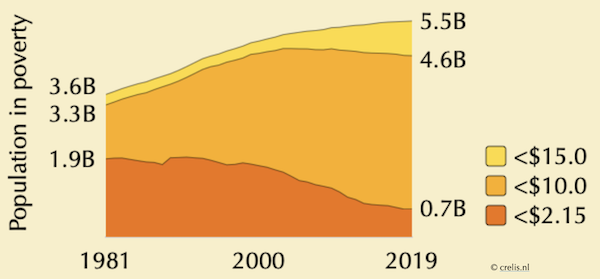
A ridiculously low poverty line

It’s easy to feel reassured by the narrative that global poverty is shrinking, especially when we hear, e.g., that the number of people living on $2.15 a day dropped from nearly 2 billion in 1981 to 702 million in 2019. But let’s be real—surviving on $2.15 a day is a far cry from actually living. A healthy diet alone requires about $6.9 per day, and some argue that an escape from poverty happens closer to $10 or even $15 daily. At those levels, the picture is far more alarming, with billions still trapped in poverty, despite the so-called progress of global capitalism. It’s time to stop celebrating superficial victories and start addressing the real needs of people around the world.

Data source: World Bank (2024), Poverty and Inequality Platform (version 20230919_2017_01_02_PROD) [data set]. pip.worldbank.org. Accessed on 2024-02-23

The feeble decoupling of emissions from growth

Recent self-congratulatory absolute decoupling of emission from economic growth in high-income countries falls far short of meeting their fair share of the 1.5°C global carbon budget. The graph below shows actual data and future scenarios for consumption-based CO2 emissions (as percentages of 2022 levels) for 11 high-income countries that have achieved absolute decoupling, along with their population-weighted average. Dark grey lines represent data from the decoupling period (2013-2019), while light grey lines cover the recession and rebound period (2020-2022). Dashed red lines project future emissions under a continuation of the 2013-2019 GDP growth and decoupling rates (business as usual), while dashed blue lines depict emissions pathways that would keep these countries within their fair share of the global carbon budget, offering a 50% chance of limiting warming to 1.5°C (not great odds, but let’s go with it). Conclusions? At current rates, these countries would take over 200 years to approach zero emissions, emitting more than 27 times their fair share of the carbon budget! To meet the 1.5°C target while maintaining economic growth, decoupling rates would need to increase tenfold by 2025. Hypothetically, if these countries manage such an energy transition (against the odds), the world would quickly run up against mineral resource limits, leaving other countries without the resources needed for their own transition. Growth is the problem.

Source: Vogel, J., & Hickel, J. (2023). Is green growth happening? An empirical analysis of achieved versus Paris-compliant CO2–GDP decoupling in high-income countries. The Lancet Planetary Health, 7(9), e759-e769.

A homework assignment for “green growthers”

Green growth proponents continue to produce flawed graphs that claim to show the decoupling of emissions from economic growth. These graphs are repeatedly critiqued, but the critiques are ignored, leading to a cycle of misleading representations. The latest iteration, now circulating on Dutch social media, is no different (see bottom-right graph). Instead of repeatedly doing their homework for them (again and again and again), let’s give green growth advocates a clear assignment: create a graph for the Netherlands—or better yet, for multiple high-income countries—that accurately compares emissions to economic growth (or even better, compares growth to various pollution flows and material resource uses). This graph should reflect historical and consumption-based data (so first, learn what this means), include all sources of environmental impact (don’t forget land use, air, and freight transportation), and ensure data transparency. It should also compare the results with global targets and fair-share responsibilities. Your grade will depend on how far back your data goes, the completeness of your sources, the range of material pressures included, and your engagement with the latest scientific literature.

The rich get richer, not happier

Neoclassical economists wrongly assume we always want more, but reality shows that beyond a certain point, more income doesn’t bring more happiness (the so-called “Easterlin Paradox”). The graph below plots 2021-2023 averages of incomes against levels of happiness (each dot represents a country). In fact, obsessing over wealth can make us less happy, burdening us with stress and alienation. Intentionally reducing consumption or setting sufficiency caps—choosing “enough” over excess—can be liberating, much like breaking free from an addiction. And that’s not even touching on the environmental benefits of embracing a sufficiency cap!

Based on the following data:
Helliwell, J. F., Layard, R., Sachs, J. D., De Neve, J.-E., Aknin, L. B., & Wang, S. (Eds.). (2024). World Happiness Report 2024. University of Oxford: Wellbeing Research Centre. https://worldhappiness.report
World Bank (2024). World Development Indicators. GDP per capita (current US$). https://data.worldbank.org/indicator/NY.GDP.PCAP.CD?end=2023&start=2021

The “Great” Correlation

The global economy has consistently grown over the past 60 years, with an average annual increase of 3.5% measured as Gross World Product (GWP) in constant 2010 US dollars. This growth rate implies a doubling of the GWP every 20 years. The GWP started at around $11 trillion in 1960 and has risen significantly to nearly $90 trillion in 2022. Economic growth has gone hand in hand with growth in global primary energy consumption (fossil fuels, renewables, nuclear). The strong correlation coefficient (R=0.9) between GWP and energy consumption highlights a robust linear relationship, indicating a “great correlation” between economic fluctuations and energy usage. During economic upswings, energy consumption increases, while downturns, such as financial crises or pandemics, lead to reduced energy usage.