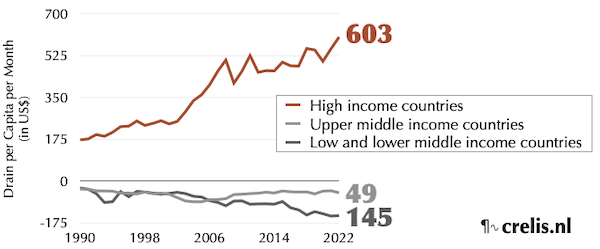
We are supposed to believe that capitalist trade is a system of mutual benefit, yet in reality it functions as a mechanism that redistributes human effort and natural wealth unevenly across the globe. This “unequal exchange” is best understood not as a set of isolated imbalances, but as the convergence of disparities in labour, materials, money, and currency that systematically advantage the global “centre” while extracting from the “periphery.” This process generates trillions in gains for wealthy economies while imposing severe proportional losses on poorer ones. The graph illustrates a widening pattern: by 2022, the average employed person in the centre effectively saved between US$213 and US$603 per month due to unequal exchange, while those in the periphery lost out on between US$35 and US$145 monthly. It is important to note that these figures are averages, with further inequalities persisting within both regions. The point is that these are not temporary distortions but structural features of the system, suggesting that justice cannot be achieved by trying to rebalance capitalism, but by abandoning it altogether.
Leave a Reply