
How Unequal Exchange Undermines Local Needs
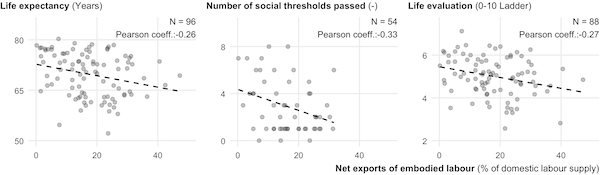
The global distribution of work is deeply uneven: high-income countries benefit from large amounts of labour performed abroad while contributing relatively little of their own, leaving lower-income countries to export a significant share of their labour in a zero-sum system. The graph highlights the consequences of this imbalance, showing that as net exports of embodied labour (measured as a share of domestic labour supply on the horizontal axis) increase, key social outcomes—like life expectancy and overall well-being—tend to decline. In other words, countries that devote more of their workforce to serving foreign demand often have fewer resources left to meet local needs. That said, the relationship is relatively weak (with correlations between −0.26 and −0.33), suggesting that while reducing unequal labour exchange may be necessary for achieving decent living standards, it is far from sufficient on its own.