The Hidden Subsidies of Unequal Exchange

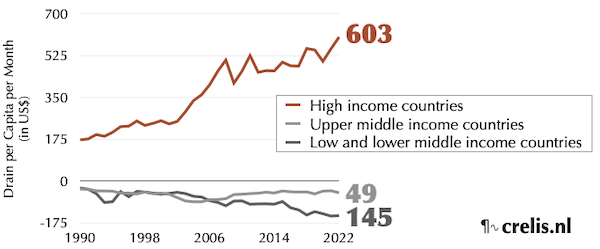
We are supposed to believe that capitalist trade is a system of mutual benefit, yet in reality it functions as a mechanism that redistributes human effort and natural wealth unevenly across the globe. This “unequal exchange” is best understood not as a set of isolated imbalances, but as the convergence of disparities in labour, materials, money, and currency that systematically advantage the global “centre” while extracting from the “periphery.” This process generates trillions in gains for wealthy economies while imposing severe proportional losses on poorer ones. The graph illustrates a widening pattern: by 2022, the average employed person in the centre effectively saved between US$213 and US$603 per month due to unequal exchange, while those in the periphery lost out on between US$35 and US$145 monthly. It is important to note that these figures are averages, with further inequalities persisting within both regions. The point is that these are not temporary distortions but structural features of the system, suggesting that justice cannot be achieved by trying to rebalance capitalism, but by abandoning it altogether.

Based on: Rammelt, C. (2025). Two Sides of the Same Coin: A Synthesis of Economic and Ecological Unequal Exchange. Capitalism Nature Socialism, 1-23.

How Unequal Exchange Undermines Local Needs

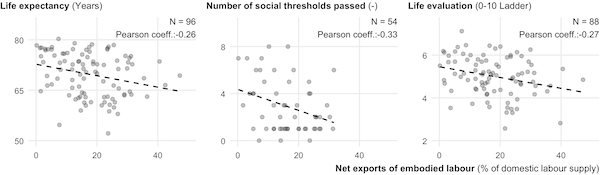
The global distribution of work is deeply uneven: high-income countries benefit from large amounts of labour performed abroad while contributing relatively little of their own, leaving lower-income countries to export a significant share of their labour in a zero-sum system. The graph highlights the consequences of this imbalance, showing that as net exports of embodied labour (measured as a share of domestic labour supply on the horizontal axis) increase, key social outcomes—like life expectancy and overall well-being—tend to decline. In other words, countries that devote more of their workforce to serving foreign demand often have fewer resources left to meet local needs. That said, the relationship is relatively weak (with correlations between −0.26 and −0.33), suggesting that while reducing unequal labour exchange may be necessary for achieving decent living standards, it is far from sufficient on its own.

Source: Godé, L., Vatn, A., & Gómez-Baggethun, E. (2026). Unequal exchange of labour and global justice: Principles for a fair international distribution of work. Ecological Economics, 240, 108838.